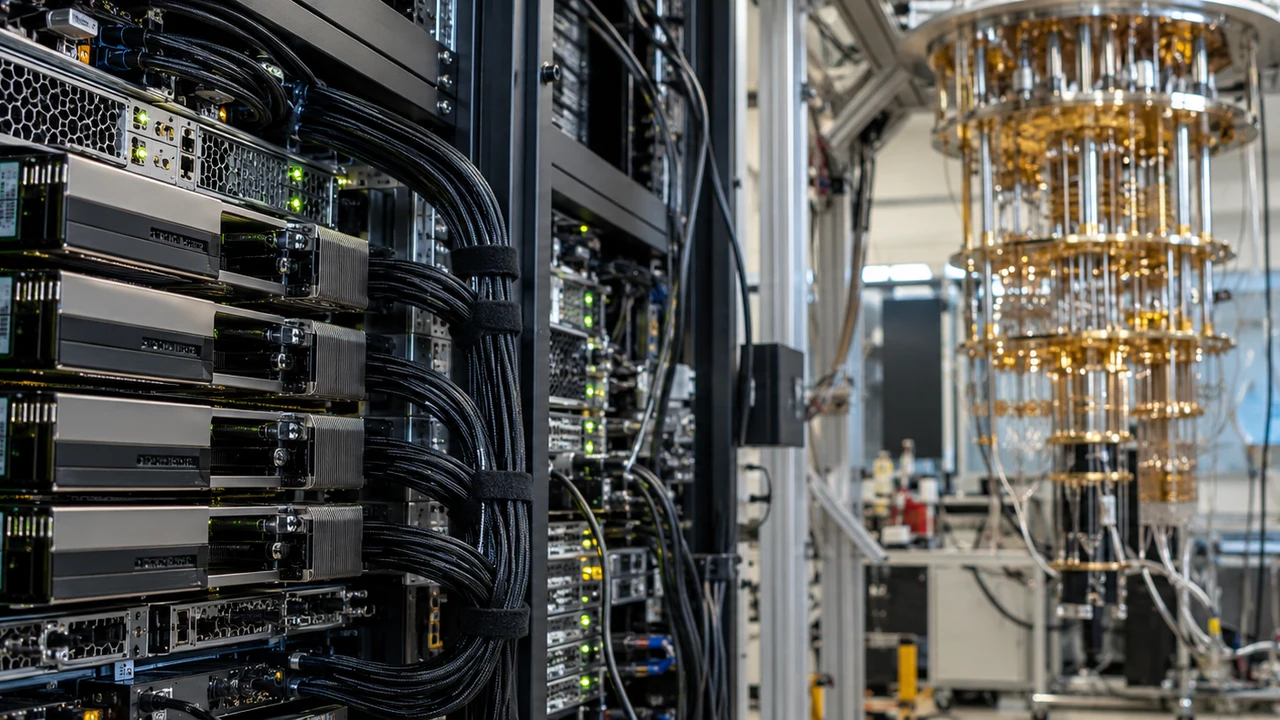
GPU & Quantum Hardware studies how future workloads may reshape accelerators, interconnects, memory, numerical methods, and hybrid quantum-classical systems. Architecture proposals are measured against real workloads and contemporary hardware—not against aspirational labels.
Questions worth building a program around.
Research infrastructure connects an algorithm to the conditions under which it actually runs. GPU and quantum-hardware inquiry at MindForge includes compute architecture, simulation, workload mapping and emerging processor concepts. The useful question is not which label sounds most advanced, but which architecture serves a specified task with measurable resource requirements and limitations.
From an idea to inspectable work.
A proposed benchmark should identify the workload, precision, hardware configuration, memory requirements and measurement procedure. Results need enough detail to separate computation from data transfer and orchestration overhead. Quantum-computing concepts require a distinction between a classical simulation, an abstract circuit model and execution on physical hardware. Architecture sketches should state assumptions about scaling, connectivity and error behavior before projecting broader capability.
Which bottlenecks matter after arithmetic throughput stops being scarce?
How should memory and interconnect design change for agentic and scientific workloads?
Where can quantum-classical orchestration outperform strong classical baselines?
- 1
Release reference workload specifications
- 2
Model performance, energy, and cost tradeoffs
- 3
Seek architecture and fabrication-partner review
Where a contribution can matter.
Contributions can include workload traces, benchmark scripts, systems analysis and hardware-design review. Compute planning should be driven by representative tasks and reproducible evidence, rather than performance promises without a measured configuration.
Program support can help fund documentation, computation, reproducible tools and qualified review. Explore research partnerships or support the institute.